
|
|
The
Baal Shem Tov, or Besht — the founder of Chasidism —
|
|
|
Eco-Torah for Sukkot (for more on Sukkot go to this page)The Shaman's RainstickDownload this whole teaching in a PDF for easy reading from here.What is a lulav? Here's the executive summary: "When Israel was encamped, the pillar of cloud was...like a sukkah and made a canopy over the tent (of meeting) from without, and filled the tabernacle mishkan from within...and this was one of the clouds of glory that served Israel forty years in the wilderness: one on their right and one on their left and one before them and one behind them and one above them and the cloud of the Shekhinah in-between them." (ch. 14 of B'raita Dim'lekhet Hamishkan, also quoted centuries later in Yalkut Shimoni, Pekudei) In Kabbalah, God is called the soveiv kol almin, what surrounds all worlds, and the m'malei kol almin, what fills all worlds. In this ancient midrash, the ultimate principle of God that fills and surrounds all, the Shekhinah or the indwelling presence of God, takes the form of a pillar of cloud that makes itself manifest within and around the mishkan, the dwelling place created for God. But the midrash also tells us that the Shekhinah dwelt "between" the people of Israel--in other words, that Shekhinah dwells on this earth when the people make a dwelling place for her "between them," that is, in their relationships and connections. We will return to this idea below. First, let's explore how the lulav itself draws God's presence into our lives and world. 1) Lulav Each of these species represents one of the primary habitats of the land of Israel: the desert, the mountain, the lowland (sh'feilah in Hebrew), and the river or riparian corridors. Each of these types of habitat is distinguished by how much rainfall and how much groundwater are found there. Together, the four species make a kind of bioregional map of the land of Israel, and they each hold in greatest abundance the rains that fell where they grow in the year that has passed. That's why the tips of each species, the pitom of the etrog, the unsplit central frond of the lulav, the end leaves of the myrtle and the willow, cannot be dried out: it would be like praying for good health while eating junk food. Bringing these four species together, we wave them in all directions around us, up and down, praying that the coming year will again bring enough water for each of these species to grow and thrive, and with them all the species of each habitat. All the other explanations you may have heard for the four lulav species (like, we wave them to show that "God is everywhere," or, they represent "the spine, eyes, lips and heart") are lovely midrashim, but this is the real reason. We are praying, fundamentally, for the climate, for the stability and sufficiency of the rain and sunshine, on which depend every being living upon the land, whether plant or animal (or fungus or bacteria). How can we make our prayers heard? We can make them heard by hearing them ourselves. When we pray for abundance and sustenance while living in ways that destroy our climate, it is like praying with a dried-out lulav, or worse, praying for health while eating not just junk food, but poisons and toxins. We need to pray for abundance and sustenance, but we also need to pray for the wisdom and ability to act consistently with our prayers, to change how we live so that we might live sustainably on the earth. As the Torah enjoins us: Uvacharta bachayim! Choose life!
What species and habitats need our special prayers this year? Some examples: Save the polar bears from drowning; save the fireflies from becoming lost; save the honeybees from colony collapse; save the coast live oaks from decay; save the old-growth redwoods from becoming lumber; save the cloud forests from vanishing; save the seas from dead zones. Not all environmental crises are our fault, but they are all exacerbated by the pressure, stress and loss of habitat created by both climate change and by our use of more and more land for our purposes (which also accelerates climate change). What can each of us do to protect the particular species in our own locale and "bioregion"? How do each of our actions and choices about what to buy and use and how to live affect species in other places? Finding out the answers to these questions is part of what we need to do to make our prayers real. All ecosystems are connected, and we cannot harm one without harming the others, so any prayers we make for individual species or places are also prayers for the whole Earth. Our prayers help us to focus on this by asking us to be aware of the fragility of life, on the fragility of all that is "suspended on nothingness", t'luyah al b'li mah. Two of the lines from the Hoshanot are especially striking: "Please save the soul from desperation! Please save what is suspended upon nothingness! Hoshana nefesh mibehalah! Hoshana t'luyah al b'li mah!" Behalah/desperation can mean all the forces that turn us away from action, that make us believe that we cannot make a difference. The way to save the soul from "behalah" is to fulfill the mission described in the Hoshanot: to act as priests and pray on behalf of all the other species, to fix what we can. Part of this process includes mourning for what is being lost, and celebrating what remains.
On Yom Kippur, in the Sefardic prayers, there are long confessions that detail every possible sin. One of the sins confessed in this list, among such varied items like "I have misled people in business" and "I ate outside a sukkah on Sukkot" is so very deep: "I have not chosen life / Lo bacharti bachayim." To do t'shuvah, repairing ourselves and returning to God, means to choose life. Sukkot teaches us how.
An object can become "impure" or tamei only when it is fully part of the human world. So, for example, if one is making a chair out of wood and has attached only three of the four legs, the chair is not finished and it's not able to become impure. The categories of ritual purity are human constructs, as the Talmud explicitly acknowledges. Nothing that is wholly part of Nature can become impure, and nothing that is in process of being made into a human artifact, but that is unfinished, can become impure. (Nevertheless, some materials, like metal, just by being extracted and refined, are considered part of the human world, even before they are made into something specific.) The essence of what it means for s'khakh to not be "m'kabeil tuma" is that it is in-between Nature and the human world, neither attached to the ground nor manufactured or turned into a human object: it is cut from the ground (or from a tree growing in the ground), but not yet re-formed or shaped into something useful or woven or tied down. The roof made of s'khakh represents many aspects of the "in-between": the interface between heaven and earth, the space between atmosphere and ground, the meeting place between us and God, but it also (and most importantly) represents the transitional space between Nature and our human-made world. Traditionally, s'khakh should cover more than half the space over the Sukkah by creating more shade than light, but it should have openings throughout, smaller than a handbreadth, but big enough to see some stars. At night with a light on in the Sukkah it may seem like there are almost no openings. But the unseen permeates what we see, like the stars that shine through the sky and the s'khakh. Shefa, the blessing of overflowing abundance, pours in, whether we are aware of it or not. The sukkah gives us the privilege and opportunity to sense this happening. An essential aspect of Sukkot is to teach us to live in the "in-between," to find shelter and comfort in vulnerability and in making ourselves open to the elements, and to bear witness to the Shekhinah-radiance that underlies all that we can experience. Being aware of the fragile liminality of our separation from God and from Nature, right over our heads, is an entry to thanksgiving, acceptance, and joy.
Sukkot reminds us that our relationships are not just with other humans, but with the world that is one step beyond the human, the more-than-human world that provides us with all that we need. All creatures are our relations. Both the s'khakh and the lulav draw us by steps toward the greater physical and spiritual reality which is the bed and bedrock of our lives. When we pray for all creatures, as our tradition bids us do on Sukkot, we act this out ritually by shaking the lulav. We wave or shake the lulav three times in each direction, returning the lulav after each wave to our hearts. A kavanah for each set of three shakes could be to shake the first time to receive blessing from the direction, from all that could come from there), the second time to send blessing to that direction (and all that dwell there), and the third time to express gratitude or to unite our hearts in compassion with the One who cares for all of them. It's not enough to hope for blessing: we call for blessing by using our whole bodies, using what we gather from the earth, and gesturing and dancing towards all the directions. We need to make this physical gesture into a real prayer by purposefully acting change our impact on the planet, to change ourselves, instead of changing the climate. What we give to the Earth must also become a blessing. A blessing for all the families of the earth, mishp'chot ha'adamah, all the tribes of species and genus, of region and ecosystem, all our relations of earth and sea and sky. This is how we can choose to act, how we can measure our actions, in an age of global climate change and uncertainty. This is how we should measure government policies, community decisions, and justice itself. This is how we can ask God to "renew the face of the ground" chidush p'nei ha'adamah, and be answered. The final dimension of action is joy: V'hayita ach sameach! And you will rejoice! The gates are still open, and the way through them is joy and service: both are the characteristics of acting as priests to bring down blessing for all our relations. May we all be blessed to rejoice, to receive the Shekhinah dwelling between us, in all our relationships, with all the creatures of heaven and Earth.
~~~~~~~~~~~~~~~~~~~~~~~~~~~~~~~~~~ |
|
|
Design in progress © Rabbi David Mevorach Seidenberg 2006 |
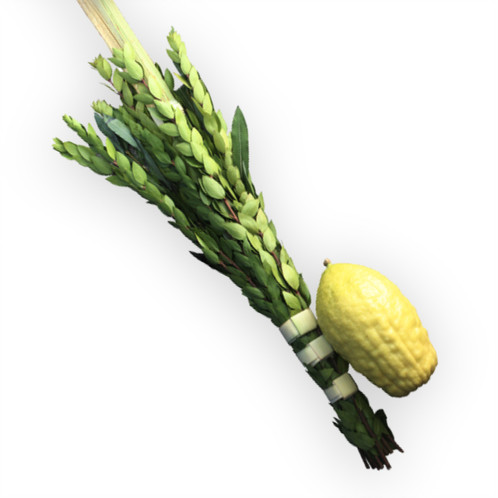 1) Lulav-Palm branch = desert